
CRISP‑TIQ™ Methodology
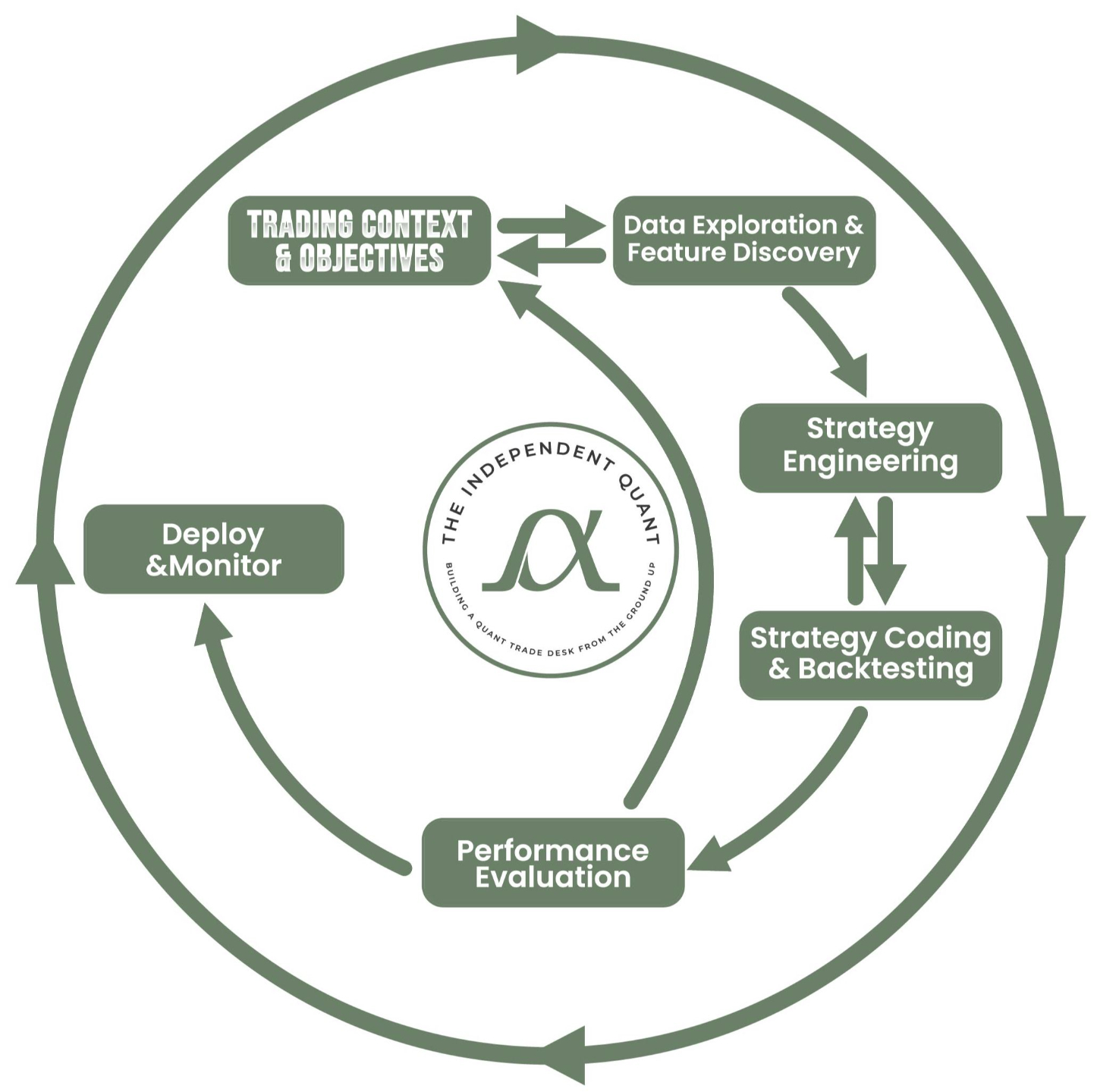

What Is CRISP‑TIQ?
CRISP‑TIQ stands for:
Codified Repeatable Iterative System for Profitability – Trading Intelligence Quantified
It is a six-phase strategy development process designed to take you from raw market ideas to live, adaptive trading algorithms—with minimal confusion and maximum structure.
A Modern, Repeatable Process for Algorithmic Strategy Design and Execution
CRISP‑TIQ™ is The Independent Quant’s proprietary strategy development methodology—built for independent traders, quant enthusiasts, and system developers who want to move from guesswork to structured execution.
Inspired by IBM’s legendary CRISP‑DM model for data mining, the CRISP‑TIQ Methodology adapts this professional-grade framework for the realities of modern trading. Whether you’re building your first algorithm or refining a portfolio of live systems, this methodology provides the clarity, sequence, and discipline to succeed.
Phase 1: Trading Context & Objectives
Objective
Define the real-world constraints, goals, and profile of the trader or strategy sponsor.
Key Tasks
-
Identify trader type (retail, prop, institutional)
-
Define strategic goals (monthly return, drawdown tolerance, capital limits)
-
Determine available timeframes and instruments
-
Clarify risk tolerance, max drawdown, recovery tolerance
-
Capture execution realities (manual vs. automated, broker constraints, latency)
Deliverables
-
Trading Mission Brief
-
Time Horizon + Capital Model
-
Objective Definition Sheet (Win Rate, R-Multiple targets, frequency)
-
Constraints Checklist (compliance, broker, slippage, tax, position sizing)
Iteration Triggers
-
Change in account size or risk profile
-
New market access (e.g., new broker or instrument)
-
Pivot in trading philosophy (e.g., from mean-reversion to breakout)
Phase 2: Data Exploration & Feature Discovery
Objective
Understand the structure, availability, and quality of market data. Derive meaningful features and filters to feed into strategy logic.
Key Tasks
-
Gather raw price data (OHLCV)
-
Ingest alternative data (sentiment, options, macro indicators)
-
Clean missing/duplicate/illiquid data
-
Identify volatility regimes, structural shifts
-
Visualize relationships between indicators and outcomes
-
Construct candidate features (indicators, filters, custom ratios)
Deliverables
-
Raw + Cleaned Data Files
-
Exploratory Data Report
-
Feature Library Draft
-
Labeling Logic for Strategy Class (trend, mean-reversion, volatility breakout)
Iteration Triggers
-
Poor signal performance in backtests
-
Discovery of higher-quality data or new alternative source
-
Changing market regime (requiring re-profiling)
Phase 3: Strategy Engineering
Objective
Translate the market hypothesis into a well-defined set of rules, signals, filters, and conditions.
Key Tasks
-
Define entry and exit conditions (price behavior, indicator thresholds)
-
Select filter logic (volatility bands, time-of-day, macro overlays)
-
Design risk model (position sizing, stop loss logic, R-multiple targeting)
-
Create pseudocode of strategy logic
-
Map logic to quantifiable variables
Deliverables
-
Strategy Design Document (TIQ template)
-
Entry/Exit Logic Diagram
-
Risk Management Model
-
Complete Pseudocode
-
Strategy Checklist (modularity, measurability, repeatability)
Iteration Triggers
-
Failed logic tests in backtest or walkforward
-
Discovery of contradictory filter logic
-
Unclear edge or lack of signal frequency
Phase 4: Strategy Coding & Backtesting
Objective
Implement the strategy in code, backtest it on historical data, and validate key logic paths.
Key Tasks
-
Select backtesting platform (QuantConnect, Backtrader, NinjaTrader, custom)
-
Translate logic to code (modular functions)
-
Test for logical bugs, overfitting flags, or data snooping
-
Run backtests over multiple timeframes and instruments
-
Store all test results with parameter/version tracking
Deliverables
-
Strategy Codebase (Python or platform-native)
-
Backtest Performance Summary
-
Equity Curve(s)
-
Error/Warning Log
-
Parameter Tracker
Iteration Triggers
-
Backtest metrics don’t meet objective targets
-
Strategy performs too well (suspected overfitting)
-
Slippage/execution unrealistic in backtest logic
Phase 5: Performance Evaluation
Objective
Objectively measure the strategy’s robustness, risk-adjusted returns, and deployment readiness.
Key Tasks
-
Run walkforward validation
-
Monte Carlo simulation of trade sequences
-
Evaluate strategy robustness (parameter sensitivity, regime shifts)
-
Compute advanced metrics (Sharpe, Sortino, CAGR, max DD, MAR ratio)
-
Compare to benchmark (SPY, risk-free rate, buy-and-hold)
-
Stress test for black swan, low-liquidity scenarios
Deliverables
-
Walkforward Test Results
-
Robustness Map
-
Risk-to-Return Summary
-
Strategy Readiness Scorecard
Iteration Triggers
-
High drawdown volatility
-
Inconsistent walkforward results
-
Failure to generalize to out-of-sample data
Phase 6: Deploy & Monitor
Objective
Deploy the strategy in a live or simulated environment and establish a system for ongoing monitoring, performance capture, and refinement.
Key Tasks
-
Choose deployment method (paper trade, live with small size, broker API)
-
Automate execution logic (cron jobs, cloud deployment, signal streaming)
-
Monitor live trades (logs, fills, slippage, latency)
-
Implement error handling + alert systems
-
Review strategy monthly/quarterly
-
Re-train or re-optimize if necessary
Deliverables
-
Live Execution Dashboard (via TIaaS or custom)
-
Performance Tracker (real vs. backtest)
-
Error & Alert System
-
Post-Deployment Review Report
Iteration Triggers
-
Significant deviation from expected metrics
-
Infrastructure failure or broker API change
-
Market condition shift invalidating strategy assumptions
